
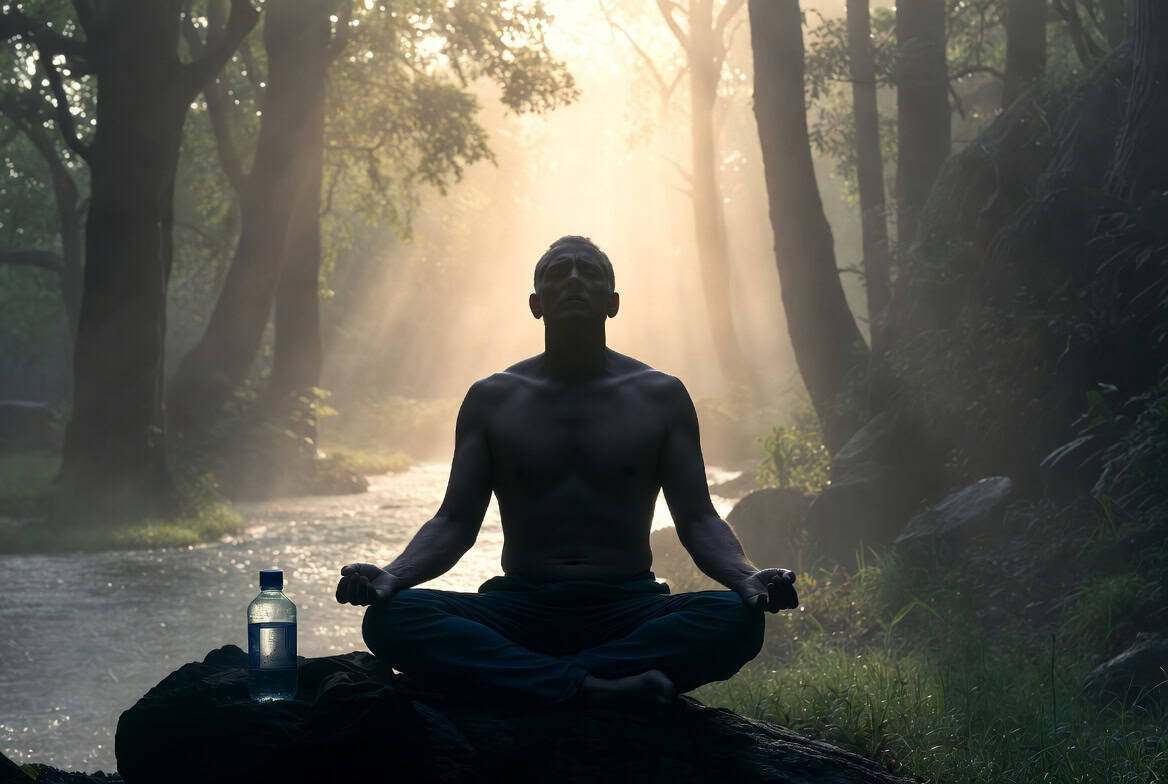
In my own individuation process, I’ve found that the most profound insights often emerge when I step outside my comfort zone through personally chosen boundary experiences. Just last month, I completed a 12-day water fast—not as an athlete pushing limits, a way to lose weight quickly, or a health trend, but as a deliberate experiment in shadow work. You can read the full story in this post.
What began as quiet curiosity about my habits became a mirror for ignored parts of myself. Hunger stripped away distractions, and repressed emotions and patterns surfaced, demanding attention. It wasn’t easy, but it showed how voluntary discomfort growth a gateway to self-understanding.
Across centuries and cultures, fasting has served as a tool for mental and spiritual growth. Religions like Christianity, Judaism, and Hinduism include fasting rituals as rites of passage, fostering spiritual clarity and humility. Indigenous vision quests often involve days without food in solitude, inviting inner encounters. Even Greek philosophers like Pythagoras fasted for mental purification.
Our Forgotten Roots – Rediscovering Timeless Traditions
Today, in an era where “God is dead” and our reliance on science distances us from spiritual depth, fasting offers a chance to reconnect with intuition. Insights from cognitive behavioral therapy and mindfulness reveal how depriving the body of comforts lowers defenses, letting the unconscious speak. Jung emphasized the body’s role in psychic processes; fasting quiets ego chatter, allowing the shadow—those rejected personality aspects—to integrate.
In this blog I don’t want to talk about losing weight or the health benefits of fasting (though they’re significant). The real value is in self-knowledge: discomfort exposes avoidance like emotional eating or suppressed anger, urging us to confront and befriend them. Intentional hardship, as in Buddhist retreats or sweat lodges, uncovers truths for growth—especially amid modern disruptions that erode autonomy.
This guide draws from my experience to provide a practical framework you can adapt, via fasting or other edge practices. We’ll cover the psychology, preparation steps, alternatives, and integration exercises. It’s no quick fix, but a tool for ongoing discovery. If you’re ready to explore your depths, let’s start with the basics.
The Psychology of Discomfort
Carl Jung introduced the concept of the shadow, those parts of ourselves we’ve pushed into the unconscious—traits like anger, fear, or unmet needs that don’t fit our self-image. Over our lives, the ego filters useful traits into our persona, the mask we wear, while storing unhelpful or counterproductive ones in the shadow to maintain control and normalcy.
This works for a while, but ignoring this unconscious part—the dark, deep reality we deny—can backfire, letting the shadow influence or even control our lives. Approaching the unconscious and integrating the shadow requires voluntary discomfort. This shadow work is key to what Jung described as individuation, the lifelong journey to wholeness and becoming who you truly are.
Physical and mental challenges like fasting lower barriers, allowing the shadow to emerge not as a threat or something pathological, but as part of our identity for integration. It’s like removing makeup and clutter to create space for real conversation. In my own fasts, I’ve noticed this around day three—irritability or old regrets bubble up, revealing aspects ignored in comfortable routines.
Why Revealing Our Shadow Feels Uncomfortable
Comfort acts as a powerful defense mechanism. We live in a world of ease: constant food access, endless device scrolling, numbingly predictable schedules. These aren’t just conveniences; they shield us from inner discomfort and hidden truths. Comfort reinforces avoidance—the ego’s whisper of “Don’t look too closely.”
When everything feels safe, we rarely question deeper motivations or conflicts. But in an age where algorithms shape experiences and technological disruptions erode autonomy, reliance on comfort traps us in stagnation. Nietzsche might call it self-deception, trading true sovereignty for superficial peace. Breaking the cycle through discomfort fosters rediscovery and greater self-awareness.
Habits for Avoidance
Addictions amplify avoidance, serving as escapes from the shadow. Food often becomes emotional armor—snacking to soothe anxiety instead of facing it. Workaholism drowns inner voices in busyness. Entertainment, like digital streams, delivers dopamine hits to distract from boredom or loneliness.
These habits aren’t always extreme; habitual phone checks can mask discontent. In Jung’s view, they stem from the shadow’s influence—unacknowledged parts projecting into compulsions. During my fasts, without food or screens, my mind wandered to suppressed job frustrations, showing how addictions quieted my call for change.
Psychologically, extended fasting mirrors shadow emergence in stages. The first 24-48 hours bring hunger and resistance—your brain amplifies cravings and doubts as the ego fights back. By day three, ketosis stabilizes energy, deepening shifts: emotions swing from euphoria to melancholy as toxins release and the mind clears. Insights arrive unbidden—memories resurface, patterns clarify. It’s nonlinear; some face anxiety waves. Research shows initial serotonin drops, then adaptations boosting focus and resilience, aligning with Jung’s accessible unconscious.
The Importance of Dreams
Dreams during fasting often become vivid and symbolic, a direct line to the shadow. Without daily overload, the unconscious compensates with richer imagery. In my experiences, dreams shifted to archetypal—encounters with forgotten selves or journeys. Jung saw dreams as compensatory, revealing what waking ignores. Fasting quiets the ego, letting deeper layers speak.
Shadow work through discomfort fits stagnant moments—midlife transitions, career dissatisfaction, or external chaos like work or societal changes. Best when stable for reflection, not in crisis. Start gradually with shorter challenges to build tolerance.
Voluntary discomfort is a practical path to human autonomy, a tool for growth. In our disrupted world of quick fixes, embracing this psychology reclaims inner sovereignty, one layer at a time.
Fasting for Shadow Work – A Practical Guide
If you decide to go for a fast, your chance of success depend mainly on whether you have a strong “Why” for doing it. And your “Why” is usually not the superficial answer you tell someone who asks you in disbelief why you do that. It’s not about “health aspects”, “detox” or “mental clarity”. Nietzsche nailed it: “He who has a why can bear almost any how.”
Without a clear why, a fast quickly turns into self-punishment, a performance, or just another challenge to tick off. With a clear why, the physical and emotional discomfort becomes something else—a container for honest self-examination. So start by answering yourself the fundamental question: “Why are you gonna fast?”
The best way to find this answer for yourself is by sitting down, take your journal and complete the following sentence: “During this fast, I want to understand my relationship with….”-what’s your blank? Control, comfort, anger, loneliness? Take your time, this is your most important reason and it can become a harbor to return when things get messy. This is the ground you’re looking for—a clear, honest intention that prioritizes self-knowledge over self-optimization.
Medical Considerations and Safety (aka When NOT to Fast)
Fasting is not a neutral tool. If you have a history of disordered eating, are pregnant, or live with serious physical conditions like diabetes or other medical situations, then forcing your body into a fast is a betrayal of the self, not a breakthrough. Jungian work is about wholeness, and the body is a vital part of that psyche. If fasting isn’t safe for you, shadow work is better served through other “edge experiences” like silence or cold exposure.
Even when healthy, there is a difference between seeking an edge and chasing an extreme. I’ve experimented with everything from 24-hour gaps to two weeks. What mattered most wasn’t the length, but whether I chose a duration that allowed me to observe myself rather than just endure. A 24-hour fast—dinner to dinner—is often enough to show you how quickly the mind begins to negotiate and dramatize. Three days usually pulls you deeper into emotional layers that stay hidden behind a full stomach. Choose a duration that fits your capability and personality. In any case, before you get started, consult with a medical professional.
When I plan a fast now, I think in terms of a “container.” I involve my wife and family into my plan, clear my calendar of high-stress meetings (at least in the first 3 days), and keep my notebook ready. Make sure, you have a trusted person (spouse, friend, mentor) that can support you. You’re telling your psyche: this isn’t punishment; this is a deliberate encounter.
How long to fast (24 hours, 3 days, longer)
Choosing a fast duration for shadow work depends on your experience, health, and readiness. Start short if new—build tolerance. Always consult a doctor; hydrate; stop if unwell. Focus on self-discovery, not extremes. In my practice, shorter fasts reveal daily avoidances, while longer ones uncover deeper shadow material amid life’s disruptions.
- 24-Hour Fast (Beginner-Friendly):
- Skip a full day of meals (water/tea only); break at the same time next day.
- Expect: Hunger peaks at meals, irritability by evening, subtle clarity emerging.
- Shadow Benefits: Notices avoidance like stress-snacking; mild ego lowering for initial insights.
- Tips: Do on weekends; journal reactions. Studies show boosted focus post-adjustment.
- 72-Hour Fast (Intermediate):
- 3 days without food; medical check advised.
- Expect: Day 1-2 resistance (cravings, mood swings); Day 3 euphoria or breakthroughs as ketosis sets in.
- Shadow Benefits: Deeper emotions surface (e.g., regrets); aligns with Jungian integration.
- Tips: Supervise if needed; track dreams. Research notes resilience gains, but anxiety possible.
- Longer Fasts (Advanced, e.g., 5-12+ Days):
- For seasoned practitioners; professional supervision essential (up to 21 days safe for healthy adults).
- Expect: Initial dips (serotonin drop, anxiety); later profound clarity, vivid dreams.
- Shadow Benefits: Strips core layers; reveals archetypes, builds sovereignty against external chaos.
- Tips: Stable mindset only; integrate slowly. My 12-day fast exposed career frustrations—transformative, but gradual start key.
Listen to your body; integration is the goal.
The Descent: What to Expect
Once the fast begins, the experience is often more ordinary—and more revealing—than people expect. The first twelve hours feel quite normal, but you’ll likely catch yourself opening the fridge on autopilot. These micro-movements are gold. They reveal how much of our eating is about rhythm and habit rather than hunger.
Between twenty-four and forty-eight hours, the resistance gets louder. During shadow work, the practice is to get curious. I write down exactly what the voice inside me is saying and ask: What is this part of me trying to protect? What is it afraid I’ll see if I keep going?
As the fast extends, physical hunger often fades into waves, and the psychological material moves to the foreground. Without the usual buffers, emotions land more directly. I’ve had moments where grief or old grievances surfaced without warning while doing something as simple as washing my face. In an ordinary week, I would have numbed that away. Here, there is nowhere to run.
Working with the Shadow
The fast becomes a laboratory. One of the most effective practices I use is Conscious Discomfort Observation. When a craving or a spike of irritability hits, I sit with it for a few minutes. I don’t try to “fix” it. I just ask where it lives in my body and what it would say if it had a voice. Often, the “hunger” is actually a mask for boredom, anxiety, or a need for connection.
At night, dreams often take on a different intensity. Jung believed dreams were compensatory, revealing what the waking ego ignores. When I fast, my dreams become more vivid and symbolic—encounters with strangers or journeys through decaying houses. I keep a journal by the bed to capture these fragments. I don’t look for a “perfect” interpretation; I just look for the themes. If every character in the dream is a part of me, what are they trying to tell me?
I also pay close attention to projections. During a fast, tiny annoyances feel massive. If a colleague’s email or a partner’s habit infuriates me, I pause. Usually, that irritation is a mirror. I’m reacting to a trait in them that I refuse to acknowledge in myself. Hunger strips away the “polite” mask, making these shadows much easier to spot.
Knowing When to Stop and How to Return
One of the most humbling parts of this work is learning to distinguish between a threshold worth staying with and a line you shouldn’t cross. If you experience intense dizziness, heart palpitations, or a level of mental confusion that feels unsafe, choose to stop. Stopping isn’t a failure; it’s an act of understanding your body and integration.
Ending the fast mindfully is just as important as the fast itself. The temptation to binge or immediately drown the experience in noise is powerful. I try to break the fast with a simple meal, eaten slowly and without distractions. Despite many fasting protocols recommend otherwise, I usually stay in a state of Ketosis for some time (this time it was 3 weeks). That means I limit my diet to fat and proteins and no carbs (eggs, butter, avocado, meat, cheese). The first bites are often flooded with emotion—relief, gratitude, or even a strange sadness that the intensity is over.
In the days that follow, I sit with my notes and ask: What did I actually learn about my relationship to comfort? What did I see about myself that I’d rather not have seen? Without that step, the fast is just an intense story. With it, the shadow begins to integrate, and the work of becoming whole continues
When Fasting is not an Option – Other Edge Experiences
Not everyone can or should fast. For some, it’s medically risky. For others, it too easily overlaps with disordered eating patterns or control dynamics that are already part of the shadow. That doesn’t mean you’re excluded from this kind of work. The core principle isn’t “don’t eat.” It’s simpler and more fundamental:
Remove a layer of comfort → reveal what that comfort was hiding.
Fasting is just one way to do that. There are many others.
For some people, the most honest challenge is extended silence. One to three days without speaking, music, or constant input can feel far more confronting than an empty plate. Without the familiar noise, the mind grows louder. Old dialogues, unresolved conflicts, and buried grief start replaying. The urge to pick up your phone “just to check something” suddenly exposes how much of your life is structured around avoiding inner stillness.
Another great way is spending time alone in nature. A solo day or weekend in the wilderness—no friends, no scrolling, just you, your thoughts, and the environment—quickly dismantles the illusion of control. The forest or mountains don’t care about your plans or persona. In that indifference, your fears, grandiosity, and helplessness become visible. Many people meet their vulnerability for the first time not in therapy, but sitting on a rock with no signal.
There are also more physical routes. Cold exposure—cold showers, river dips, winter walks—makes the body protest instantly. The shadow often appears in that protest: the part that demands comfort at all costs, or the part that quietly believes, “I’m too fragile for this world.” Endurance challenges—long hikes, runs, or sustained exertion—surface similar material. Fatigue strips away the polished self-image and reveals how you talk to yourself when you’re at your limit.
Then there is what I’d call creative fasting: deliberately stepping away from a specific comfort like social media, streaming, music, or constant stimulation. A few days without screens, or without any background sound, can be astonishingly uncomfortable. Suddenly, boredom shows up in full force. So do the feelings you were buffering: loneliness, restlessness, envy, the sense that your life isn’t moving the way you wanted. Again, the point isn’t deprivation for its own sake. It’s to see, with clarity, what your comforts have been shielding you from.
Whether you choose silence, solitude, cold, exertion, or a break from digital anesthesia, the underlying movement is the same. You remove an automatic comfort, stay long enough to feel the rawness beneath it, and watch what your shadow does when it has one less place to hide.
Conclusion
Shadow work through discomfort is not a formula; it’s an ongoing relationship with yourself. Whether you choose fasting, silence, cold, solitude, or something entirely different, the invitation is the same:
Design your own edge experience—one that is honest, challenging, and safe enough to stay present with.
You don’t have to do this alone. Community, whether in the form of a trusted friend, a group, or a guided community like The Small Reset, can hold you accountable and help you integrate what you discover. This isn’t a one-time event or a heroic cleanse. It’s a practice—returning, again and again, to the places where your shadow hides, and meeting what you find there with increasing courage and compassion.
Recent Posts
Staying Human in the AI Age: Watts, Jung, and the Philosophy of Irreplaceable Value
You're scrolling through LinkedIn at 11 PM. Another post about AI replacing jobs. Another thread about prompt engineering. Another expert claiming you need to "adapt or die." And somewhere in your...
What 12 Days Without Food Taught Me About My Shadow: A Jungian Experiment
Our modern bodies have long forgotten they are built to survive without constant calories. We're bombarded by snacks, soft drinks, and delicacies—every lobby has a bowl of sweets, every fridge...