

You’re 45, staring at your LinkedIn profile, realizing your “Senior Manager” title feels more like a life sentence than an achievement. And the speeding AI job disruption makes you wonder when you’re ultimately becoming obsolete.
Be honest, how much of your self-worth is tied to your job title?
With the rise of artificial intelligence, our society moves into a corporate identity crisis, and you can face that happening right now in real time. All these modern hierarchies and structures that were manifested in the last decades start to shatter and fall apart.
Humanity has already faced several industrial revolutions, and each of them was more rapid and more disruptive than the previous one. The introduction of the computer changed our way of how we engineer, process data, and create content. The internet revolutionized our way of communication and entertainment.
The AI Revolution: A Catalyst for Midlife Reinvention
AI and robotics will impact and alter each and every area of our lives. Each previous revolution made millions of jobs and functions redundant, but it also created new possibilities and more wealth for the people.
While it is clear that AI and robotics will also make many jobs obsolete—McKinsey, for example, mentions that 57% of US work hours could be automated by 2030—the open and controversial question remains whether these technologies create new jobs and opportunities. It might just happen that through the possibilities that robots and machine intelligence provide, a larger amount of human work will just not be needed anymore. Too powerful are these technologies.
The Impact on Professionals: Feeling the Heralds of Change
This obviously will also have a large impact on working professionals. And if you’re honest with yourself, you might admit that you feel already its heralds.
The corporate identity crisis is even amplified by structural problems of our work culture itself. The corporate world promotes obedience and job title hierarchy, neglecting that 20 years of specialization can lead to corporate burnout.
For you, this drastic development doesn’t have to be necessarily a bad omen. Instead, you should use it as a wake-up call for personal midlife reinvention and to make sure you benefit and won’t stay behind.
In this post, we’ll dive into the psychology of job title identity, trace its historical roots, and how we got to where we stand today. We also expose how corporate structures create deliberate dependency. Drawing lightly on Nietzsche’s slave vs. master morality and Jung’s persona concept, we’ll show why AI is the wake-up call you need—and how personal sovereignty offers an escape where skills and systems replace titles.
In 2022, I made a radical cut. I transformed myself from a “successful” corporate engineering director to a sovereign individual through geographic and economic liberation and becoming a true value creator based on my own values. Let’s unpack how your job became your prison, starting with the myth of career stability.
The Illusion of Lifetime Jobs: How We Got Here
The Post-War Boom: Creating Security at the Cost of Freedom
Since World War II, the Western world has faced an era of economic and political stability. This led to ever-increasing prosperity and rising life standards for the majority of our societies. In times of wealth, the desire for higher security rises, because we obviously don’t want to have our lives and situations changed for the worse.
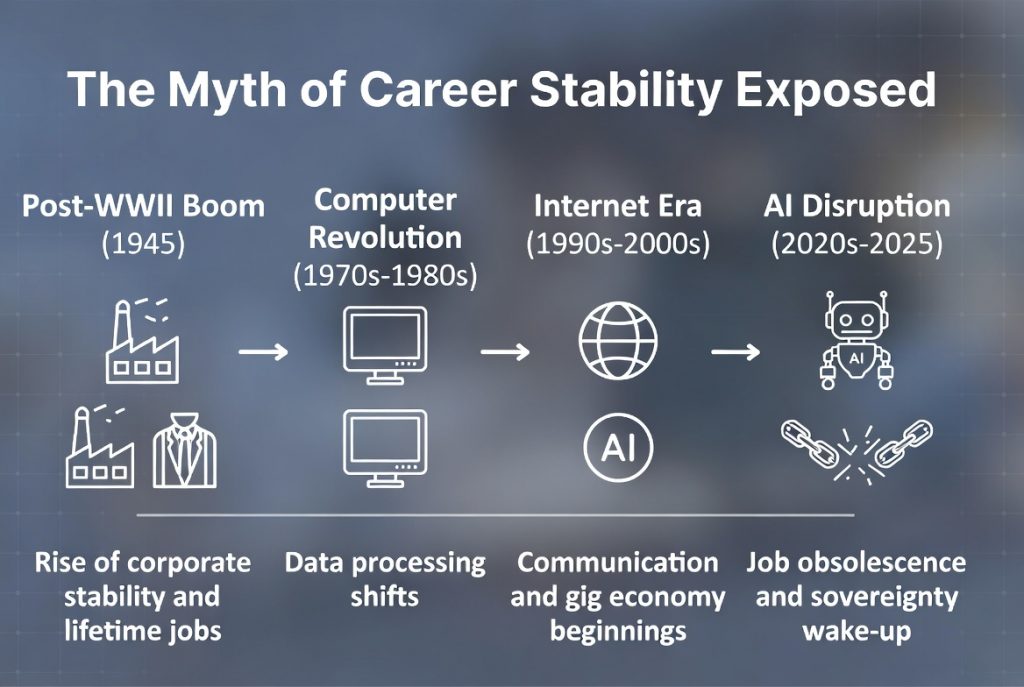
Our corporations reacted to this need by increasing social benefits for their workforce: worker unions, pensions, and hierarchies where employees could strive and grow. However, this security also generated a culture that fosters loyalty over innovation.
F. Nietzsche introduced a concept that states that people can either develop a master or a slave morality. The “slave” mindset incorporates following rules, avoiding risk, and fearing conflict and uncertainty, while the “master” morality embraces power and creates value through self-overcoming. Corporate roles usually encourage slave morality.
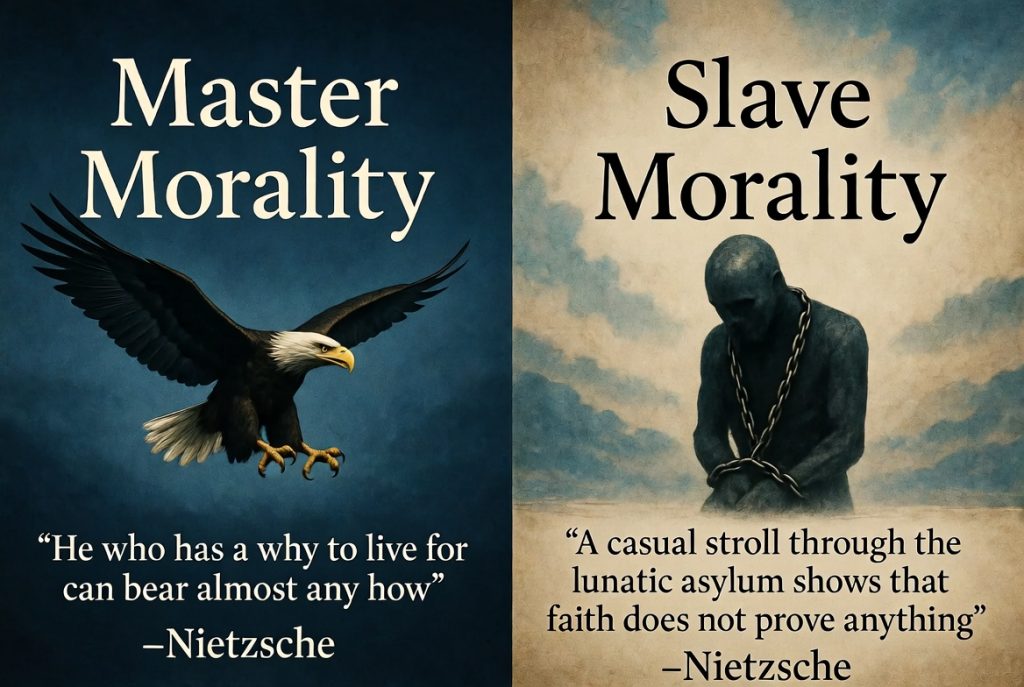
Most people don’t see this in their early career stages. They are motivated to climb the corporate ladder, make money, and be successful, which requires conformity. When these professionals reach their 40s or 50s, they often realize they’ve been “slaves” to the system.
This leaves two options: Continue until retirement, enjoying comfort but facing growing unfulfillment, or make a radical change.
AI Job Disruption: The Breaking Point
AI job disruption exposes this vulnerability and forces action. Automation targets specialized roles that were prestigious just two years ago, like marketing, engineering, or coding, making job titles and traditional skills obsolete.
Our generation is dealing with corporate burnout and many of us are going through an identity crisis career. Engineers realize work acquired over decades can be done faster by AI tools. Even managers aren’t safe, as AI handles strategy, market analysis, HR, and financial planning. Experts estimate 50-99% of current jobs will be replaced within 5-10 years.
That is what Nietzsche meant when he said “God is dead.” Today, we see in real time how the corporate god is dying, killed by disruptive technology and a transforming society.
Understanding this history reveals the deliberate design behind corporate dependency—let’s explore the psychology at play.
The Psychology of Job Title Identification
Why your job title feels like your identity – and how AI shatters it
Our ego constantly craves validation. We want confirmation that our actions and behaviors are “good” and “valid.” Ideally, this comes from internal validation, judging ourselves based on intrinsic value and moral compass. However, this requires self-reflection to understand who we really are, our main drivers, and where we want to go.
In our modern world, we depend largely on external validation: opinions from friends and colleagues, or promotions and pay raises confirming we’re doing well. This shifts belief from our own judgment to social standards. Media and social media amplify this conditioning, fusing self-worth with titles and status symbols.
We aren’t born with this dependency, but education and careers manifest it. 20 years of specialization create a competitive advantage but also “learned helplessness.”
Jung’s Persona Concept: Why Our Masks Shape Our Identity
C.G. Jung introduced the concept of archetypes as part of our whole. According to Jung, the “Self” is our true identity—the person we really are. However, this Self is often reflected by the “Persona,” the masks we wear in daily lives.
We have different masks for contexts, like professional life versus friends or family. It becomes problematic when the corporate persona overrules the Self’s true desires. Learn more about how we cover ourselves with masks in differen situations in this video.
Nietzsche understood this half a century earlier, urging “to become who you are,” meaning to uncover authentic potential behind roles. If you’re a midlife professional feeling trapped, facing burnout syndromes or AI anxiety, these concepts help understand the mechanisms and rediscover authenticity for reinvention in a changing world.
AI will burst the Corporate Value System
AI will bring a rapid end to this conditioning. In recent decades, the job market valued knowledge workers like data analysts, senior computer scientists, and marketing specialists—titles that spark pride on business cards and LinkedIn.
The harsh truth is these jobs will be first to become obsolete, forcing identity re-evaluation. So, prepare for the future of work 2025 whether you want to or not.
In our other blogs and videos, we explain shadow work as a method to connect with our collective unconscious, getting back to roots and authentic paths by uncovering rejected aspects like untapped creativity.
This conditioning isn’t accidental—it’s a psychological trap corporations designed for loyalty. But there’s a way out: embracing sovereignty.
Breaking Free: Sovereignty as the Alternative Path
From Prison to Liberation: Building Sovereignty where skills trump titles
Personal sovereignty allows you to design life according to your values, standards, and goals. It rests on three pillars:
- Economic liberation: Eliminate company dependency. Build income streams through AI entrepreneurship, investment, and passive incomes.
- Existential liberation: Free yourself from old gods and standards. Create your own table of values.
- Geographic liberation: The world is a village. Choose your residence consciously, optimize for work-anywhere freedom and tax structures.
Liberation is the process, sovereignty the goal. Starting now prepares you better than 95% of peers. Shift to AI-proof skills like automation to thrive in the new era.
Nietzsche saw sovereignty as the highest self-mastery, embodying master morality—not ruling others, but discipline and self-overcoming.
Jung provides practical guidance through “individuation,” the path to becoming who we are.process, that he calls “individuation”. This is the path we have to walk to become who we are.
My Personal Individuation Story: Lessons from the Journey
Here, I share my personal individuation story. For years, I climbed the corporate ladder until realizing I was trapped. I made a radical cut, discovering new ways despite challenges. It was worth it—I never regret it. Read my personal transformation story in this blog.
A key realization: The past doesn’t matter. We fall into the sunk cost fallacy, thinking invested time in a career means we can’t change. But if you’re off track, redirect sooner.
Today, four years after resigning, I live with geographic independence, creating meaningful values in harmony with myself, nature, and my environment. When things don’t go as planned, I accept and learn—amor fati, as Nietzsche would say.
If inspired, start preparing not by quitting immediately, but by setting the stage to release chains of expectations. Here are three immediate methods:
- Self-reflection: Meditate, journal, disconnect. Listen to yourself without external input.
- Audit your skills vs. job title: Focus on irreplaceable human skills.
- Stop consuming, start creating: Even privately—magic happens through creation.
View AI as an ally for new wealth and possibilities if flexible. Use it as a tool, question outputs, and remain the master.ool, question and validate everything and not to be manipulated by it. Be the master in this relationship.
Conclusion
In this blog, we saw how corporate culture created dependency over decades. Many are stuck in this trap, but it’s not a life sentence—it’s your wake-up call for midlife career change.
AI is the catalyst destroying old standards, creating winners and losers. Use it to pave your path to sovereignty and independence.
Your corporate identity crisis isn’t the end. It’s the beginning of becoming the master of your fate, the captain of your soul.
Ready to uncover if your current mindset is holding you back from true sovereignty in the AI age? Take our free Business Mindset Test now— a quick 15-question assessment designed for midlife professionals like you. Discover whether you’re stuck in “slave morality” mode (conformity and dependency) or ready to embrace the “master” path of self-overcoming and value creation, as Nietzsche envisioned. Get personalized insights on shifting to AI-proof entrepreneurship and economic liberation. Start the Test Here and begin your small reset today!
FAQ
What is a corporate identity crisis in the AI age?
It’s the realization that your job title identity has fused with your self-worth, amplified by AI transformation professionals facing obsolescence and corporate burnout.
How can Nietzsche’s master vs. slave morality help with midlife career change?
Master morality encourages self-overcoming and value creation, shifting from corporate dependency to personal sovereignty, while slave morality highlights the traps of conformity.
What role does Jung’s persona play in identity crisis career?
The persona is the professional mask that can overshadow your true Self, leading to burnout; integrating it through shadow work fosters authentic reinvention.
Is AI a threat or opportunity for future sovereignty strategies?
AI job disruption is a threat to outdated roles but an opportunity for AI entrepreneurship, automating tasks to enable economic and geographic liberation.
How do I start building personal sovereignty?
Begin with self-reflection, skill audits, and creation. Explore our Sovereignty Scorecard Intensive for systematic guidance on existential liberation and midlife reinvention.
Can midlife professionals really achieve geographic independence?
Yes, by leveraging AI tools and sovereignty strategies, many transition to location-independent lives, as I did, optimizing for freedom beyond traditional careers.
Recent Posts
Prologue When I had grown fat and green by the corporate lake, I noticed that this life no longer answered my questions. Amid all the noise, the silence was shattering. So I went up into the...
The Invisible Costs of Living Abroad: Understanding & Planning
50% of Germans dream of a better life in another country. Yet few dare to take this step. Sun, freedom, new cultures, and a fresh start—that's the image suggested by digital nomadism or geographic...